This is Post 5, the close of FireTech's brow light series. Posts 1–4 cover why FireTech and which family to use. This one is how a dealer, OEM spec writer, or department apparatus officer turns that into a package that survives the bid and the body shop.
- Part 1: Why FireTech Brow Lights Beat a Generic Scene Bar
- Part 2: BG2 and UIP: A Smarter Brow Light
- Part 3: FireTech Brow Lights and the 72" 3-Piece Kit
- Part 4: Minibrow Packs the FireTech Brow Into A Tighter Package
The working rule: don't write a part number until you can answer the cab, the job, and the electrical budget. Lumens come after those three.
The intake: nine questions before a SKU
Put these on the quote sheet. If the salesperson can't answer them, the spec is a guess.
- What is the cab, and is the leading edge straight or radiused? E-ONE Quest, Sutphen, and Rosenbauer are the usual 3-piece conversation. A straight edge can take a one-piece 46 / 65 / 72 / 80.
- Engine, aerial, ambulance, or retrofit? Aerials often want the 54" two-piece split. Ambulances use the same families at different lengths. Retrofits inherit hole patterns and marker locations you don't get to pretend are optional.
- What already lives on that roof? Warning lightbar model and height, existing markers, horns, cameras, air horns, brow leftovers from the last truck.
- Are identification / clearance lights supposed to live in the brow? If yes, you're in FMVSS 108 and SAE J2042 territory. Read What Are Marker Lights? before you float three amber dots in the leftover gaps.
- Does the department want a bar, or a system? Bright forward scene only → classic Brow Light. Glow / Go, dimmable warning, traffic director, HAAS Alert, cab-matched extrusion → BG2 plus the UIP.
- Where else on the truck needs light? Sides, rear, and body panels are MiniBrow, not a second cab brow. Recessed if the body can't take a surface bar.
- White or black, and does it have to match the warning package? Finish isn't performance. Mixing finishes on the same visual line is how you get a change order at paint.
- What is the electrical budget at 12.8V? A 72" classic brow is in the low-20-amp range. A long double-stack MiniBrow can outdraw it. BG2 scales with module count. Add it up before the electrician does.
- Who is going to change modes on scene? If the answer is “the firefighter,” budget the UIP. A smart fixture with no crew-facing control is a shop toy.

Cab geometry first, catalog second
This is the decision that prevents the most expensive mistakes.
Straight leading edge. One-piece classic Brow Light in the length that matches cab width and the marker plan. Or BG2 on a front-of-cab extrusion if the department is buying the system, not just the bar.
Radiused leading edge. Write the 72" 3-piece kit on purpose. Don't put “72-inch FireTech brow” in the bid and hope the OEM picks the right chop. Sam has said the quiet part in the trade press: the multipart brow exists so rounded cabs can actually run the light.
Aerial / split front. Use the 54" two-piece kit language, then confirm the current SKU with FireTech. Don't copy a part number you can't defend.
Warning bar already specified. If the truck is getting an OMEN, plan the J-foot so the brow or MiniBrow hangs under the bar. One hole pattern. No second constellation of mounts on the cab roof.
BG2 on a named cab. Don't reverse-engineer a module count from a photo of another department's rig. Use the front-of-cab / side-of-cab / side-of-body / rear-of-body configuration guides on the BG2 product page and get a FireTech part number. Custom extrusions are the product. Guessing isn't.
Starter packages you can actually defend
These are starting points, not frozen bids. Change lengths to the cab. Change optics to the surface.

Engine, proven spec.
Classic one-piece or 3-piece Brow Light on the cab (markers if the ID lights are coming out of the brow). Combination or split-circuit scene on the front. Single-stack MiniBrow on the sides with FT optics forward and flood aft. Double-stack or a longer single-stack on the rear. J-foot under the warning bar if the bar allows it.
Engine, next-gen spec.
BG2S on a cab-matched front extrusion. UIP in the cab. Decide traffic-director and HAAS behavior now, not at pre-construction. MiniBrow on the body the same way as above. Don't skip the UIP to “save the panel.” You just bought a system the crew can't run.
Aerial.
54" two-piece or a 3-piece if the cab radius demands it. Confirm SKU. Watch the aerial’s front geometry, baskets, monitors, and warning packages steal the same inches. MiniBrow on the body; recessed where outriggers, compartments, or a clean side sheet cannot take a surface bar.
Ambulance.
Shorter classic brow or MiniBrow on the cab brow, depending on width and whether split circuits are required. Single-stack MiniBrow along the module. Flood toward the rear doors. Combination toward the front corners. Keep profile low; ambulance roofs are already crowded.
Retrofit.
Measure the existing brow, the radius, and the marker layout before anyone orders. A one-piece 72" won't become a 3-piece in the field without a new kit. Match hole patterns where you can. If the old bar covered or crowded the center ID light, this is the moment to put markers back on a legal spacing, not to repeat the last shop's workaround.
Optics belong to the surface, not the order form
Write the optic next to the location, not as a global option.
If the quote says “all MiniBrow, combination, black” and nothing else, send it back. That's a color choice with a lumen number attached.
Markers, mounts, and the holes you only get to drill once
- Integrated markers are optically grouped in the FireTech brow: independent LEDs and optics in a shared housing. Scene off doesn't mean markers off.
- Vehicles 2032 mm or wider still have to satisfy FMVSS 108. Putting a scene bar next to markers isn't the same as burying the center ID light in the middle of a flood.
- Cab bracket = 3" radius. Pedestal = flat. L-foot = vertical surface with the rail still supporting the extrusion. Trunnion = MiniBrow lengths that need a wider aim envelope. J-foot = under an OMEN.
- Recessed MiniBrow stays adjustable after it's in the pocket. If the body builder pours it in as a fixed can, you paid for a feature you didn't get.
- Support the extrusion along its length. Two end brackets on a long bar is how housings flex and how moisture shows up two years after delivery.

Electrical math the bid should show
You don't need a full load-management thesis. You do need a line that proves somebody added.
- Classic 46" brow: about 14A at 12.8V (180W). 72": about 22A (285W). 80" with markers: about 25A (315W).
- Single-stack MiniBrow scales roughly 2.3A / 30W per 6-LED step at the short end, up through the mid-teens of amps on the long bars.
- Double-stack MiniBrow can run 15A on the 36 LED, 22.5A on the 54 LED, 30A on the 72 LED, 37.5A on the special-build 90 LED. That last one also has MOQ / short-run surcharge. Don't treat it as shelf stock.
- BG2 is per-module (32W peak class on the 4" module) plus whatever the UIP and system manager draw, which is small. Module count is the budget.
- The UIP's low-voltage protection is a safety net. It's not a substitute for a load analysis.
Write the expected amp draw next to each fixture on the quote. The electrician will anyway. Better if you did it first.
Spec language that does not collapse in purchasing
Ambiguous:
Provide LED brow lighting and scene lighting as required.
Defensible:
Cab leading edge shall be a FireTech Brow Light, 72-inch three-piece kit with integrated DOT marker lights, part number FT-B-72-ML-3PKIT-\* (housing color to match cab), mounted on rail-style feet. Identification lights in the brow shall be optically grouped and remain operable independent of scene circuits. Body side and rear scene lighting shall be FireTech MiniBrow, combination optics on forward-facing positions and flood optics on rear-facing positions, lengths as shown on the lighting layout. Warning lightbar, if FireTech OMEN, shall use J-foot mounts so the brow hangs under the bar.
For BG2, name the location, the configuration guide, the UIP, and the functions (Glow / Go, traffic director, HAAS) instead of “modular LED brow.” Purchasing cannot bid a photo.
Mistakes that come back as change orders
- "72-inch brow” on a Quest / Sutphen / Rosenbauer cab with no 3-piece callout
- MiniBrow specified as the cab brow to shave cost — it is a single-circuit tool
- BG2 specified without a UIP, then the department asks how to switch Glow / Go
- Markers treated as decoration, then the truck fails a lighting inspection
- All combination optics, including the rear
- Special-build 90-LED double stack written as if it ships with the rest of the order
- 54" two-piece aerial kit copied off a stale table row
- Second mount pattern punched for a brow that could have hung under the OMEN
- Electrical budget that counts the cab brow and forgets three double-stack MiniBrows
- Finish mismatch against the warning package after paint is locked
Who writes the part number
Dealers can spec catalog classic Brow Lights, MiniBrow lengths that are on the product pages, mounts, and colors from the intake above.
Call FireTech before the bid leaves the building when any of these are true:
- BG2 module count and cab extrusion
- 54" two-piece aerial kit (confirm SKU)
- Special-build MiniBrow lengths or the 90-LED double stack
- Marker layout that has to satisfy an existing hole pattern
- Mixed warning-plus-scene behavior on BG2, including HAAS
- Anything where the photo of last year’s truck is doing more work than the drawing of this year’s cab
The Bar Style collection is the shopping list. The five posts in this series are why each line is on it.
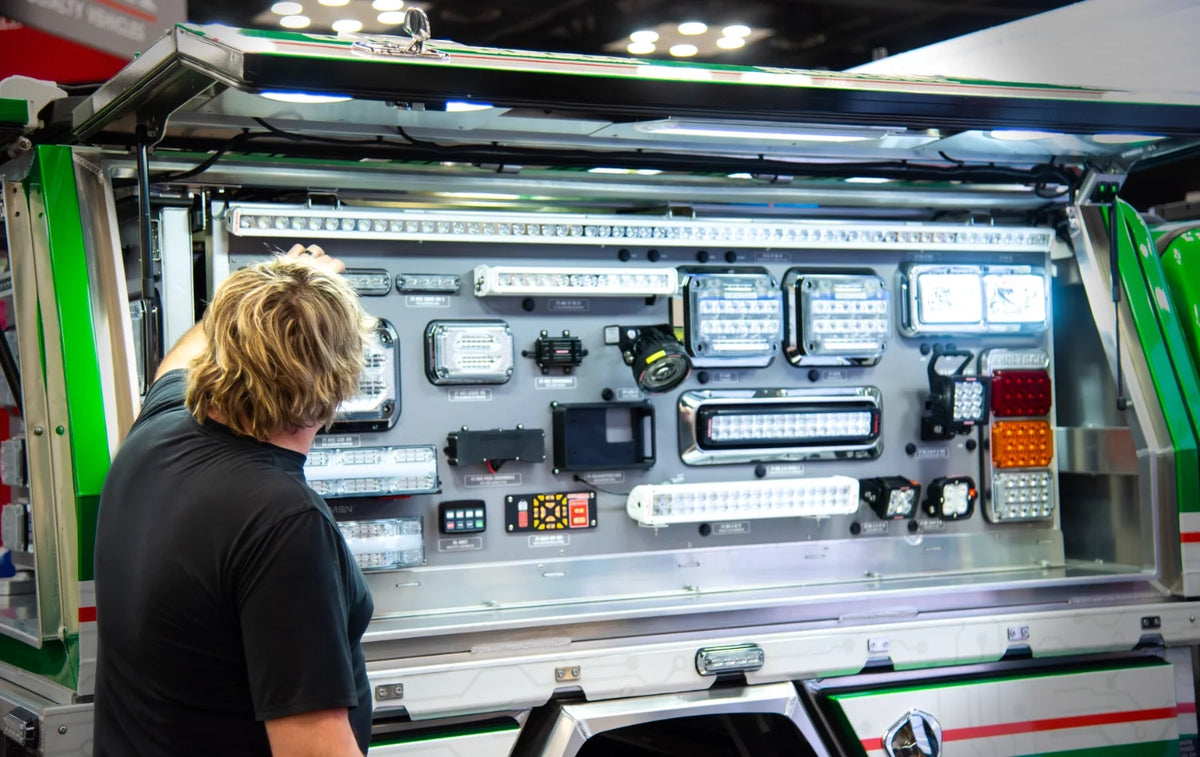
Questions on a specific cab? Get a FireTech specialist on the drawing. The right package is the one that fits the roof line, the marker plan, and the way the crew actually works the scene, not the one that looked brightest on a table at a show.